


The world vs. the Word on food
Like many people who have become interested in health and nutrition, I was led in it through my own health issues.
I became a Christian in high school and shortly afterwards started college at the Air Force Academy, where, like many college, students, I was suddenly trading home cooked meals for a diet of nearly all pre-made, processed foods.
Food at the Air Force Academy is an explicit display of everything modern food is made to be: fast, convenient, and mass produced.
The dining hall is one of the largest in the world. It’s a single room that spans 1.7 acres and can feed 4,000 people in 20 minutes. While the food that’s doled out to individual tables is served in hot, metal bins that might resemble unique, warm meals, it’s basically pre-prepared and re-heated.

This is the norm for what many people subsist off of at home and from restaurants. Think about typical fast food. Imagine an office worker who hops in his car over lunch break to grab a chicken sandwhich. He eats it hurriedly in his car as he sits in traffic on his way back to work.

This kind of food is, of course, made to be eaten fast. It’s designed to only require one hand and no silverware.
There is no variation or seasonality in the food. This is one of the appeals of chain restaurants after all; you can go to any Chick fil-A anywhere in the country any time of the year, order the same thing, and you know exactly what to expect. The food is not subject to differences in geographical regions or seasons of the year, like waffle fries only being available in Idaho or late summer.
These kinds of foods don’t require any intentionality in their procurment of consumption. There is no engagement with their production, and no necessary connections with community or family. You could, of course, enjoy a fast food meal with friends and family, but it’s certainly made to not require that.
And, of course, these kinds of foods are contributing to the chronic disease epidemic, but I won’t get into the details of that here.
Suffice to say, when I finished college, I started experiencing some health symptoms. My health problems were thankfully very minor compared to what many people experience that drive them to take their health into their own hands, but when I started experiencing some low blood sugar and digestive symptoms, I went to a doctor at the military base hospital. I had done a little research beforehand and asked about low blood sugar and IBS (irritable bowel syndrome).
I was quickly told that IBS is not real. They ordered a blood sugar lab and told me if my blood sugar did turn out to be low, I might just have to carry sugar pills around with me.
When the blood sugar lab came back, they told me it was, actually, normal.
Another doctor I visited told me this might all be anxiety and prescribed me what he said was an “anti-anxiety” medication.
When I looked at the prescription after leaving his office, I found it was actually an anti-depressant, which was prescribed off-label sometimes for anxiety—a risky medication with serious side effects that can be difficult to get off of. I threw away the prescription right there and committed to figuring out the answers myself.
It didn’t seem right to me that these relatively minor symptoms were inherent defects that could never be fixed.
I knew that God’s creation is good, my body wasn’t just broken, and there had to be root causes and solutions in God’s creation.
This is when I started researching health and nutrition on my own, and I was fascinated with it. But I can see now how it is easy for people who have been hurt by the conventional medical system to be too quick to accept anything alternative, and this is exactly what I did at first: If information was coming from people who were also independent thinkers and fought back against the mainstream narratives, then we were on the same side and they had to be right.
So I started trying anything and everything I was reading about online.
At one point I planned to do a juice fast, just because I’d heard people talk about it. I went to the store and bought some big bottles of Naked brand juices. I don’t think I had any idea what I was doing or why.
Some of the people I followed online talked about “plant-based diets”. It’s embarrasing to admit now, but I didn’t even realize what this meant. I just thought of plants as natural and clean and good, so eating more plants had to be a good thing right? I went so far as to buy a bag of lentils before I realized something incredibly obvious: All foods we eat, with the exceptions of pure minerals like salt, are either plant or animal-based. So eating more plants, or “plant-based”, meant eating less meat. I can thank my parents for instilling enough sense into me growing up to know that meat and butter and other animal-based foods were not unhealthy, so this was the point where I at least started rejecting the plant-based narrative.
In another instance, I undertook a fast of eating nothing but whole cucumbers. I genuinely wish I could remember now what I was thinking or where I had gotten these ideas from. My blood sugar still wasn’t in a good place and it got very low very fast. I can’t think of many times I’ve felt as bad as I did by the end of that first day. I managed to go to sleep but woke up dizzy with a racing heart. I ran into the kitchen and ate some cookies and instantly felt much better.
It didn’t take long to realize that so much of the health and wellness information out there is confusing, contradictory, and constantly changing, whether it is coming from the conventional or alternative spheres.

The truth is that news thrives on information that is novel and attention-grabbing. Social media functions the same way, and a kook making wild claims can get attention and rise to the top, regardless of if what he is saying is true, or even if he believes it himself.
One thing I stuck to more consistently for quite a while because it had helped me was a paleo diet. This was very popular at the time and it helped me improve some breathing issues I had and feel a little better.
A church group I was involved with at the time included a lot of members who participated in CrossFit. Paleo was heavily adoped by CrossFit gyms so I found many friends in this group who also followed a paleo diet! I lived with a few of the girls for a time and we took turns making paleo dinners for the rest of the house. I thought it was great.
But at one point, visiting a friend from college, the friend’s mom, a very devout Christian lady who worked hard to cook scratch meals for her family, rebuked me for my paleo diet! She told me the diet was based on evolution, an anti-Christian concept, and so it was wrong to avoid foods like grains that God had made and that the Bible spoke positively about.
At the time I reasoned that just because grains were given in the Bible didn’t mean we had to eat them, and I didn’t think much about it.
During this time, though, I still dealt with low blood sugar problems, hormonal imbalances, and acne.
I adoped another popular method at the time, which still exists as a favorite go-to for health concsious people: cutting out more and more foods, with the belief that a mysterious allergy or sensitiviy must be the problem, and pairing down to some highly specific, bioindividual set of foods will be the answer.
For those not already eating paleo, grains and dairy are a popular first target. They aren’t evolutionarily consistent—right? People evolved as ape-like hunter gathers, they didn’t cultivate grains or raise animals for milk! You’re not a baby animal! I bought into these arguments without much consideration at all for how they aligned with my Christian beliefs. I was pretty content to keep health and faith separate.
Taking time to examine how worldviews affect nutrition advice, however, shows us that a conventional, entirely evolutionary view of human history, plays out in two major, distinct ways.
The first is the foundation of the paleo diet: that we should be eating the way humans evovled, as hunter-gatherers, or maybe even animals. No grains, no dairy, no elaborate preparation methods, maybe even no cooking at all? This is the origin of the kind of belief that any human interaction with nature inherently makes it worse. Nature is perfect the way it is and humans are a blight on the earth.
Not long ago I listened to a podcast debate between two medical doctors. One argued that humans should eat hardly any fruits or carbohydrates because humans evolved as hunter gatherers eating primarily meat, with only limited, low-sugar fruits they might be lucky to find in the summer. (Interestingly, I happen to know that this doctor is a Christian.) The other argued that because people evovled around the equator with access to plenty of high-sugar tropical fruits, we should be eating a diet high in carbohydrates, but only from fruit or honey. It’s interesting that a lot of the “science” we’re exposed to is really based on worldviews, even religous beliefs, and there isn’t even consensus what the most conventional, accepted view is.
Now, I respect and have learned a lot from both of these doctors. Just because someone has a different worldview than mine doesn’t mean I have to reject everything they teach, it just means I should know why they believe and teach certain things and need to discern what to leave and what to take. This also doesn’t mean there isn’t good science behind some of the claims of paleo, keto, carnivore or anything else, or that people don’t experience real benefits from them, but there is a lot of nuance to understand there.
The second major way evolution plays out in modern nutrition is the belief that we are more evolved than people of the past, and therefore there is nothing to learn from those who came before us. They didn’t have modern science and were just superstitious, right? We have electricty, the internet, and smartphones! So surely every new innovation—microwave foods, pharmaceutical medications—is worth adopting without a second thought to what they are replacing...
An open-minded and searching medical doctor I spoke with once illustrated this perspective very well with a personal example. His family was originally from India and he told me that his grandfather used to tell him to remove the skins of almonds before eating them. He thought this was a silly, baseless belief of unscientific people of the past and ignored it. That was, until he learned something he’d never been taught in medical school—that the skins of almonds contain a concentrated dose of the nut’s internal defenses, chemicals that can inhibit the absorbtion of nutrients and harm the digestive system.
Ascetic nutrition
Among all the different things I tried and experimented with during this time, and even as I started to see some of the anti-Christian worldviews behind much of the health and wellness information, I was still completely bought into one of the most prevalent dogmas about food: the more enjoyable a food is, the less healthy it must be.
This dichotomy between healthy and satisfying is foundational to almost every school of thought out there in the nutrition space. It’s an assumption for most people as they navigate nutrition themselves. If a food is tasty, sweet, or satiating, it must not be good for you.
Making healthy choices means opting for self-control over indulgence. As the 20th century nutrition and fitness guru Jack Lalanne was known for saying, “If it tastes good, spit it out!”

One of my goals was to make food as practical as possible. I tried to come to see it as nothing but fuel. I believed the more I could detach any kind of enjoyment or celebrations from it, the closer I would be to achieving the ideal diet.
But it is so natural to use food for these purposes that it was a constant struggle. And when I failed, I would often try to make up for it by doubling down.
For many people, this dichotomy leads to not only thinking of enjoyable foods as unhealthy, but also morally bad. Sometimes the language is just playful, like this 1970s cookbook, but often it’s truly part of how people start to think about food.

When we start thinking this way, any time we fail the insurmountable task of always denying our natural cravings, we can start to feel guilt and shame.
The breakdown of reality
Well, our culture is quick to attack anything that might be making people feel bad about themselves, but without a better solution to promoting health than the enjoyable-healthy dichotomy, they attack the very idea that there’s anything wrong with unhealthy food at all.
Check out this article from a Registered Dietician, which states, “No one food has the power to harm our health. The only foods that are truly “bad” to eat are foods you are allergic to, or foods that are spoiled or rotten.”
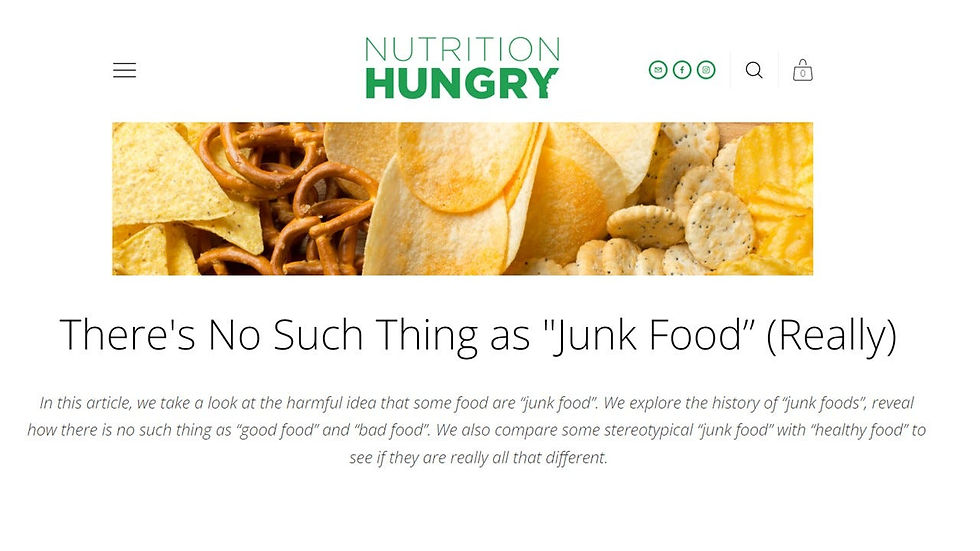
When that advice fails to keep us healthy, then we have to resort to the next step of denying reality, which is to pretend that health problems really aren’t health problems at all, like the public health initiative “Healthy At Every Size” which reflects the failure to keep any chronic health conditions under control and the attempt to scrape up a last-ditch victory to at least just make people feel good about themselves.

A different way forward
Over time it became increasingly clear to me the world’s information on health and wellness was confusing, contradictory, and constatnly changing, even when it came from the altnerative space.
How did health and nutrition information get to be this way? Shouldn’t science be able to definitely answer straightforward questions like ‘What is the ideal human diet?’ and ‘Is meat good for you or bad?’
The reality is that science, and especially nutrition science, has many limitations. I go into much more detail about what these are in my book. Modern science is also not the same as the objective method of testing and observation that is the scientific method. Today’s science is more scientism, a humanistic worldview that believes that the only reality is material, and that therefore, God cannot be real, which means scientific conclusions or “consensus” are often simply the most plausible explanation given the starting assumption that God cannot factor into the conclusions.
In the void of clear, unchanging scientific conclusions about nutrition (and even with it, because it is human nature) people come to conclusions based on pre-existing beliefs and other factors that influence what they want to be true.
It can be very hard for people to reverse course on a belief they’ve already invested in, like a diet they have built an online identity around. The human brain percieves admitting wrong the same as physical pain.
But as I continued to search for answers, I found some teachers who were truly open-minded, willing to admit when they were wrong and change course. I found others who were willing to question every conventional and alternative belief in the quest for good science, making no starting assumptions and working from the ground up rather than any pre-existing foundations.
And what I found was an ordered, cohesive pattern for distinguishing helpful and unhelfpul foods, a universal framework for cutting through the constantly changing, confusing, and contradictory information out there. And I found that the conclusions I was coming to were spiritual, with deep themes of enjoying food and caring for God’s creation.
I was convicted that I should have been approaching nutrition all along by starting with the question, ‘What does the Bible tells us about food?’
God’s Word on food
To start, the Bible tells us is that foods not morally good or bad. All foods are clean under the new covenant.
For everything created by God is good, and nothing is to be rejected if it is received with thanksgiving (1 Tim 4:4)
Foods do not give us any special moral righteousness.
Food will not commend us to God. We are no worse off if we do not eat, and no better off if we do. (1 Cor 8:8)
Jesus explicity declared all foods clean.
And he said to them, “Then are you also without understanding? Do you not see that whatever goes into a person from outside cannot defile him, since it enters not his heart but his stomach, and is expelled?” (Thus he declared all foods clean.) (Mark 7:18-19)
1 Cor 6:12 gives a good way to think about the distinction between the intentional choices we make with food and the moral freedom we have:
‘All things are lawful for me,’ but not all things are helpful. ‘All things are lawful for me,’ but I will not be dominated by anything.
While all foods are lawful, not all are helpful to meeting health and possibly other spiritual goals.
To determine what foods are helpful, a starting point is understanding the goodness of God’s creation.
And God saw everything that he had made, and behold, it was very good. (Gen 1:31)
When God declared this, it included us, our bodies, and food. While the fall certainly marred creation, it didn’t completely negate the goodness of it or the natural order that God created to our health and healing, which uses the foods He put on Earth for our sustenance.
Contrary to how much of modern medicine views our bodies, they are not fundamentally broken. True genetic defects are a rare problem—most of our health problems are caused by not living the way we were designed to.
The foods specifically given by God and celebrated in the Bible include all major food groups. When God called His creation good, it included fruits, grains, carbohydrates, fats, all of it. The key to a healthy diet per the Bible is not removing any fundamental food group or macronutrient.
The goodness of God’s creation also reaches our appetites. While most modern diets treat our cravings like they are broken—only leading us to unhealthy foods and too much food if we listen to them—a Biblical approach to health should lead us to a radically different conclusion. If we’re craving fat, or carbohydrates, or more food, there’s an important reason why for our health.
This is why we don’t have to relegate food to a purely utilitarian necessity. Not only can we use food for enjoyment and celebrations, the Bible is full of examples and commands to do so.
In the Old Testament, every commanded period of important religious observations weren’t called holidays—every one was a feast (Lev 23). Jesus’ return in Revelation is celebrated the same way (Rev 19).
Now, there are surely many highly appetizing foods out there that are indeed unhelpful for our health, so how do we distinguish between them and those that are helpful?
My framework for a Biblical, healthy diet
“Natural” is the metric many diets used to try to make this distinction. The more natural, the better! I believe this is a good starting point because God’s creation is good just the way it is, but it’s not the whole story.
In Genesis 1, God gave man dominion over Earth. The word “dominion” often has a negative connotation today because there are so many examples of humans interacting with creation in ways that make it worse, but doesn’t have to be this way and it’s not God’s intention. “Dominion” is certainly a positive, Biblical concept.
In a way, Biblical dominion is the opposite of “natural”. It means interacting with creation, ordering it, embellishing it, caring for it, and improving upon it. It’s turning the wilderness into a garden.
On the contrary, interaction with creation that I would not consider Biblical, God-glorifying dominion is all that degrades, damages, and seeks to replace it.
Good dominion is mutually beneficial for man and creation. Good food is supplied for man and the wilderness becomes more beautiful. Animals provide food for people, and in return they are cared for, given a good life (even if it is cut short), and given the ability as a species to multiply beyond what they could have naturally.
Some tangible examples of the foods that result from poor dominion: when we sought to replace the good, God-given fats in creation, we made seed oils. When we stopped treating farm animals with care and dignity, we made low-quality meats with less nutrients and lower quality fat. When we tried to short cut God’s natural order for raising and preparing foods, often because of lies that the natural method was harmful, we created all kinds of food additives that have marred modern foods.
So the kinds of foods that are appetizing but unhelfpul are because of low-quality foods we have designed by ignoring the natural order and goodness of God’s creation, not because natural appetites for fat, carbohydrates, protein, or more calories are fundamentally a flaw in our design.
So Biblical nutrition is not about putting a Biblical spin on pre-concieved beliefs. It’s much more than just calling “natural foods”, “God-given natural foods”. And it’s not at odds with science; it’s a different worldview to approach science with than the athiestic humanism behind most modern science. It’s a guide and a fact check to interpreting nutrition science. And it directs us to honor the wisdom of generations before us, understanding that we are not more “evolved” than people of the past (like the 5th commandment tells us).
Embracing foods from this framework has allowed me to start healing the health problems that were stubborn to my previous diets and experiments, like acne and infertility. It has led to more engagement with God’s creation and community. And it has allowed me to enjoy food more and have a better relationship with it than I have in a long time.
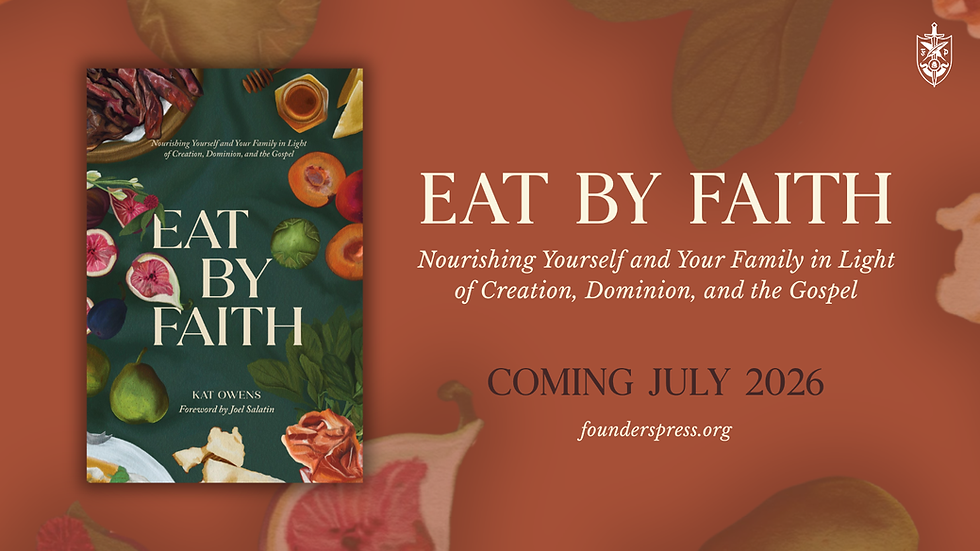
This blog post is based on the information in my upcoming book Eat by Faith: Nourishing Yourself and Your Family in Light of Creation, Dominion, and the Gospel. Learn more about the book or pre-order here.
Comments